

How EDR, SIEM, and SOC Work Together
How alternative investment firms can embrace enterprise AI while strengthening governance, protecting sensitive data, and maintaining operational control.
Read the website version of the brief
Artificial intelligence is rapidly becoming one of the most transformative technologies in financial services.
From investment research and document summarization to operational efficiency and workflow automation, alternative investment firms are finding new ways to incorporate AI into everyday business operations.
But for many organizations, AI adoption is moving faster than AI governance.
Employees are using public AI tools without oversight. Sensitive firm information may be copied into unsecured platforms. Compliance and security teams often lack visibility into who is using AI, what information is being shared, and whether existing security controls extend to these emerging technologies.
This growing challenge is commonly referred to as Shadow AI—and it represents an increasingly important cybersecurity, compliance, and governance risk for the alternative investment industry.
At Atlas Technica, we believe AI adoption should accelerate innovation without increasing operational risk.
As the industry's first Managed Intelligence Provider (MIP), Atlas Technica developed the Secure AI Foundation (SAIF) to help firms establish a secure, governed AI operating boundary—one designed to enable innovation while protecting sensitive data and supporting regulatory expectations.
What Is Shadow AI?
Shadow AI occurs when employees use artificial intelligence tools that have not been approved, monitored, or governed by their organization.
This can include:
- Uploading investment committee materials into public AI platforms
- Using ChatGPT or other AI assistants with confidential client information
- Summarizing due diligence documents through unsecured AI applications
- Creating reports using AI tools outside established company security policies
These actions are often well-intentioned. Employees are looking for ways to work faster, analyze information more efficiently, and take advantage of powerful new technology.
The problem is a lack of visibility and control.
Unmanaged AI usage can introduce risk across:
- Data leakage
- Regulatory compliance
- Client confidentiality
- Intellectual property
- Cybersecurity
- Operational governance
If a firm cannot see how AI is being used across its organization, it becomes significantly more difficult to manage the associated risks.
Why AI Governance Matters More Than Ever
Alternative investment firms have invested heavily in cybersecurity, identity management, cloud infrastructure, and data protection.
AI introduces an entirely new operating model.
Unlike many traditional applications, enterprise AI may be capable of accessing sensitive internal information, generating business content, analyzing proprietary investment data, and interacting with multiple systems across the organization.
Without appropriate governance, firms risk losing control over fundamental questions:
Who can use AI?
What information can AI access?
Which AI platforms are approved?
How is AI activity monitored?
Are compliance and security requirements being maintained?
A secure enterprise AI strategy should therefore be built on governance from day one—not added after deployment.
What Is Secure AI Foundation (SAIF)?
Secure AI Foundation (SAIF) is Atlas Technica's enterprise framework for establishing a secure and governed AI operating environment.
Rather than simply deploying AI tools, SAIF establishes the governance layer that allows firms to adopt and scale AI responsibly across the organization.
The framework is centered around three foundational pillars:
Governed Access
Control who can use AI, which applications are approved, and under what conditions employees can access them.
Data Boundaries
Keep sensitive investment, client, and operational information within managed security controls rather than exposing it through unapproved public AI services.
Auditability
Establish greater visibility into AI usage for compliance teams, security leadership, and regulatory review.
Together, these pillars create the foundation for an AI environment that is not only innovative—but controlled, observable, and built for enterprise use.
Four Core Components of Secure AI Foundation
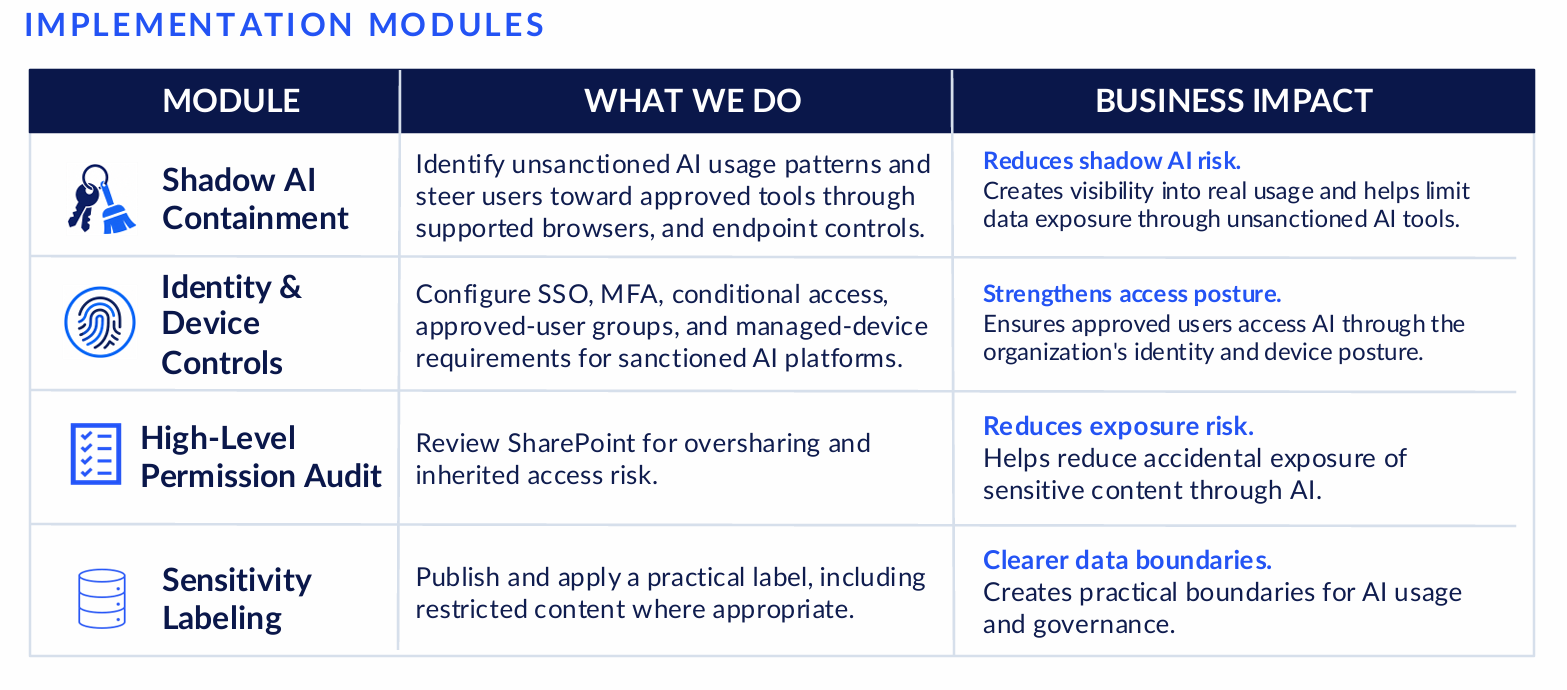
1. Shadow AI Containment
Organizations cannot govern what they cannot see.
SAIF helps identify unsanctioned AI usage patterns and guides employees toward approved enterprise AI platforms through supported browsers and endpoint controls.
Business impact:
- Reduced Shadow AI exposure
- Greater visibility into AI usage
- Lower risk of sensitive data leakage
- More consistent adoption of approved AI platforms
2. Identity & Device Controls
AI access should follow the same enterprise security standards as other critical business systems.
SAIF strengthens the AI environment through controls including:
- Single Sign-On (SSO)
- Multi-Factor Authentication (MFA)
- Conditional Access
- Approved user groups
- Managed device requirements
The objective is straightforward: only authorized users, operating within approved environments, should have access to sanctioned enterprise AI platforms.
3. Permission Audits
AI is only as secure as the information it can access.
Before AI begins interacting with organizational content, firms need to understand where existing permissions may expose information more broadly than intended.
SAIF reviews Microsoft SharePoint permissions and inherited access to help identify and reduce oversharing.
By addressing permissions before scaling AI, firms can significantly lower the risk of accidental exposure of confidential or sensitive information.
4. Sensitivity Labeling
Proper data classification creates clearer boundaries for enterprise AI.
SAIF helps firms establish and apply practical sensitivity labels so that information requiring additional protection can be appropriately identified and governed.
This creates a stronger foundation for protecting confidential investment, operational, and client data as AI becomes more deeply integrated into the organization.
AI Governance Doesn't End at Deployment
Deploying enterprise AI is not the finish line.
It is the beginning of a new operating model.
As employees incorporate AI into more workflows and business functions, governance must evolve alongside adoption.
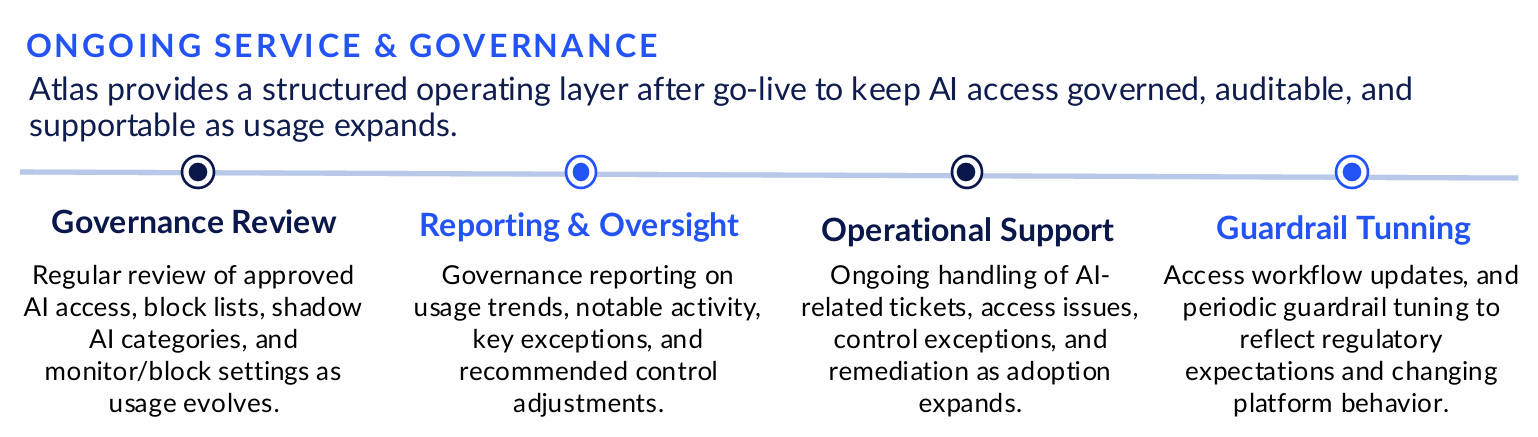
SAIF supports an ongoing governance model that can include:
- AI governance reviews
- Usage reporting and oversight
- Operational support
- Guardrail tuning
- Access management updates
- Exception handling
- Policy refinement
This ongoing approach helps firms maintain appropriate controls as AI platforms, regulations, security risks, and business requirements continue to evolve.
Why Alternative Investment Firms Need a Managed Intelligence Provider
Alternative investment firms operate within a unique intersection of regulatory requirements, sensitive financial data, operational complexity, and cybersecurity risk.
Their approach to AI should reflect that environment.
Atlas Technica is purpose-built for capital markets.
As the industry's first Managed Intelligence Provider (MIP), Atlas Technica brings together:
- Managed IT Services
- Cybersecurity
- Cloud Infrastructure
- AI Governance
- Enterprise AI Strategy
- Operational Support
The objective is not simply to deploy another technology platform.
It is to help firms institutionalize intelligence safely, securely, and responsibly.
The Business Value of Secure AI
A governed AI framework delivers more than stronger security.
It gives organizations the confidence to move faster.
A secure AI foundation can support:
- Faster, more confident AI adoption
- Reduced Shadow AI risk
- Stronger cybersecurity posture
- Improved regulatory readiness
- Greater protection of sensitive data
- Enterprise-wide AI governance
- Better visibility into AI usage
- Sustainable long-term AI operations
Governance does not have to slow innovation. When implemented effectively, governance becomes the infrastructure that allows innovation to scale.
Build Your Secure AI Foundation
Artificial intelligence is transforming the alternative investment industry.
The firms positioned to succeed will not simply be the ones that adopt AI faster.
They will be the ones that govern it better.
Secure AI Foundation (SAIF) helps organizations establish the controls, governance, and operational framework required to move from unmanaged AI experimentation to secure, enterprise-wide intelligence.
With the right foundation in place, firms can innovate with greater confidence while protecting the data, clients, operations, and reputation that matter most.
Ready to Build a More Secure AI Strategy?
To learn more about Secure AI Foundation (SAIF) or discuss how your firm can securely adopt enterprise AI, contact the Atlas Technica AI Advisory team.
Let Atlas Carry the Weight of Your IT
Whether you’re scaling your firm, modernizing infrastructure, or strengthening your security posture, Atlas Technica provides the confidence that comes from having the right technology partner in place.
Schedule a ConsultationAbout Atlas Technica
Atlas Technica was founded in 2016 with two main goals: to provide the best customer service experience possible for our clients, and to use best-in-class public cloud technology to do so. There is a clear need among hedge funds and other alternative investment firms for an IT provider that will put service first. Atlas Technica’s mission is to shoulder the burden of IT management, user support, and cybersecurity compliance so you don’t have to.